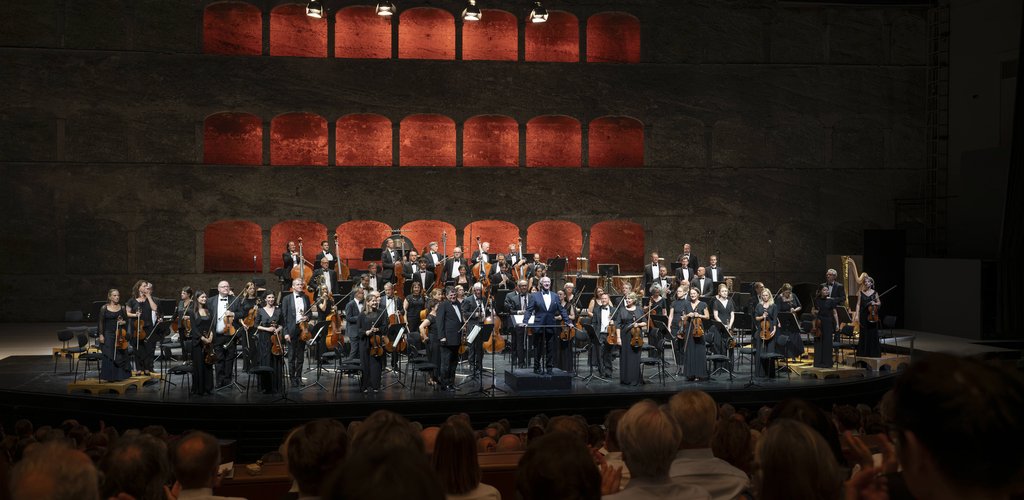
Iván Fischer and the Budapest Festival Orchestra received an enthusiastic response at the Salzburg Festival. The program presented at the Felsenreitschule on 8 August featured works by Schubert, Kurtág and Mahler. According to the reviews, which praised the richness of the sound, the authenticity of Iván Fischer’s interpretations and the orchestra’s extraordinary ensemble playing, the BFO created an intensely powerful musical experience that captivated the audience from the very first note to the last. And indeed, the audience responded with loud bravos and a standing ovation.
According to BR-KLASSIK critic Oswald Beaujean, the orchestra impressed the audience with its sound alone: “We could delight in wonderful wind solos; the strings had a velvety, impressively rounded sound, and the orchestra and conductor performed at a very, very high level.”
In Schubert’s Unfinished Symphony, Fischer and the BFO “followed the flow of the melodies completely, bringing beautiful details to the fore while never losing sight of the overall arc.” The review thus highlights one of the most important strengths of the performance: its sensitivity to detail combined with a confident command of the overall structure.
The Online Merker review also draws attention to the special significance of the program. As a child, György Kurtág heard Schubert’s Unfinished on the radio and fell in love with music as a result. The opening work of the concert was therefore not merely a classical masterpiece, but also established a personal connection between the Hungarian composer, who is celebrating his 100th birthday this year, and the other works on the program.
A special highlight of the program was Kurtág’s Movement for Viola and Orchestra, composed in the 1950s. BR-KLASSIK describes the work as bearing the unmistakable influence of Kurtág’s revered model, Béla Bartók, while already revealing the later composer’s distinctive language: a rejection of Romantic virtuosity and a concentration on small, expressive musical gestures. British violist Lawrence Power performed the work “with a wonderfully rich, sensual viola sound, with great dedication and conviction,” according to Oswald Beaujean. In his encore, Imitazione delle Campane from Johann Paul von Westhoff’s Third Solo Sonata, Power also demonstrated “breathtaking virtuosity.”
Online Merker also pays particular tribute to Iván Fischer’s presence as a conductor: “Iván Fischer’s movements are guided by the work of both heart and mind, and ultimately by his devotion to his inherited gift. The radiance of his charisma simply does not let the eye look away.” The critic also emphasizes that the conductor’s youthful energy and his direct connection with his musicians captivated the audience as well.
Mahler’s Symphony No. 1 was another major highlight of the evening. According to Beaujean, Fischer “never” plays the work in an exaggerated manner, yet unfolds it “with extraordinary richness of detail, with all the necessary clarity and drama.” The finale, meanwhile, convincingly leads towards “that singing, hymn-like outpouring into which the young Mahler allowed his First Symphony to flow unbroken.”
The Online Merker critic goes even further: “Fischer unfolded the content of this work, rich in heterogeneous elements, across its four movements with such authenticity that it would probably have surpassed even Mahler’s own conception.”
Of the orchestra’s performance, the critic writes: “His orchestra seemed almost to immerse itself in worlds of sound of unearthly beauty, in the dynamic contrasts and rhythmic precision, while, with the temperament so characteristic of Hungarians, it ventured almost to the limits of physical endurance.” According to the critic, the BFO’s “pictorial musical language” captivated everyone, filling the walls of the Felsenreitschule with an “eerie atmosphere.”
The Online Merker author also conveys the extraordinary intensity of the concert through the audience’s reaction. The performance began at 9 p.m. and held the sold-out hall in “breathless attention and suspense” until 11:15 p.m. At the end, a “veritable avalanche of ovations” expressed the audience’s gratitude for the exceptional performance by the Hungarian musicians.
Perhaps the reception of the Salzburg evening is best summed up by a sentence from the BR-KLASSIK review: “It was an evening worthy of the Festival, celebrated with corresponding enthusiasm by the rapturous audience.”
The Online Merker critic concludes the review on a personal note: “We cannot be grateful enough to the Hungarians for this. As a Hungarian myself, I bow respectfully before the achievement of this orchestra. The audience celebrated!”
Sources:
