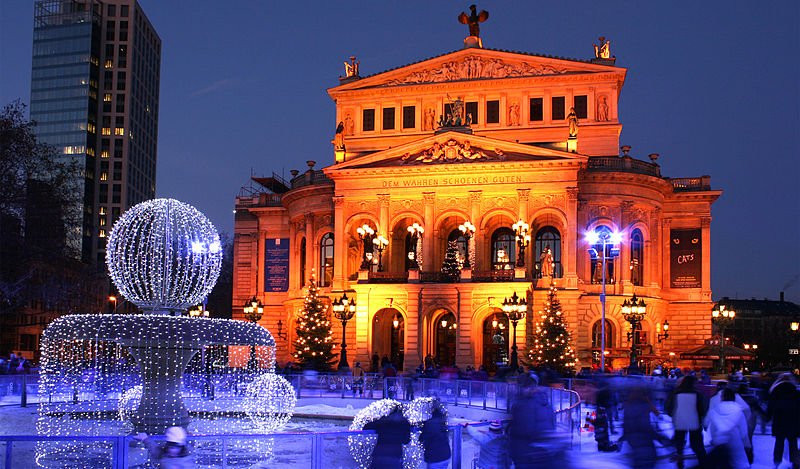
Tour: Beethoven Ninth in Frankfurt
Fischer
Program
Featuring
Conductor
Soloist
- Maria Bengtsson (soprano)
- Olivia Vermeulen (alto)
- Andrew Staples (tenor)
- Hanno Müller-Brachmann (basso)
With
Choir master
Other information
The event is about 95 minutes long.
About the event
An Eighth and a Ninth, one that is unfinished and one that closes an oeuvre – the Budapest Festival Orchestra is visiting Frankfurt with two iconic symphonies. The concert will open with music by Schubert, who, in addition to inventing the genre of German songs – writing more than 600 of them – after six symphonies arrived at an entirely new orchestral language, even if the piece ultimately remained unfinished. Beethoven’s last, longest and most monumental symphony is at once the embodiment of the ideas of the genius and the rebellious artist, as well as the celebration of the whole of mankind, which will also be beautifully symbolized by the international artists involved. It is a work that pushes - and indeed breaks down - boundaries in every sense of the word, as it incorporates the human voice into a purely instrumental genre, with the singing in the finale in Schiller’s poem set to music – which has become the anthem of the European Union – of how “all men become brothers”.
Although it is referred to as the Unfinished, Schubert’s Symphony No. 8, which in fact had been composed before his Seventh Symphony, is actually whole, with its two completed grandiose movements. The composer set to writing the piece in 1822, at the height of his prowess, but was forced to leave it unfinished with the onset of his illness which would later prove fatal. The symphony only premiered some forty years following his death. The opening theme of the first movement, performed on the low strings, immediately transports the listener to an ominous atmosphere. “This is the symphony that Schubert wrote but never finished,” we could sing to the tune. Later, the somewhat more positive main theme is also interrupted painfully several times; there is only a glimmer of hope at the very end of the movement. The atmosphere of the second movement is even more uncertain. Tender ppp melodies alternate with dramatic outbursts, but the movement – and, thus, the entire piece – ultimately ends on an elevated note.
In 1817, the London Philharmonic Society invited Beethoven to London and commissioned him to compose two new symphonies. Eventually, the composer combined his two ideas. After the first three movements more or less in line with 18th century traditions, Beethoven included four vocal soloists and an enormous chorus in the closing part. For the text, he chose Schiller’s Ode to Joy, which he had been planning to set to music since his Bonn years.
The opening movement emerging from hushed silence and continuing with the main theme bursting in commences the work as a kind of depiction of creation. Instead of the usual order of movements comes the scherzo, which is not in the least light-hearted or charming but rather dark and obsessed. However, the more hymn-like middle section seems to foreshadow the joy of the finale. The slow movement with variations provides a pleasant contrast to the earlier storms. In the style of a “recap of previous episodes”, the finale leads us once again through the path of chaos, struggle and relief via the themes of the earlier movements, making the entry of the first vocal soloist a truly cathartic experience. The monumental series of variations beginning here culminates in life-affirming ecstasy at the work's conclusion.
The composition has been a raving success ever since its world premiere, particularly when performed with soloists like the “exceptionally touching” Maria Bengtsson (The Daily Telegraph), the “wonderfully luminous and captivating” Olivia Vermeulen (Frankfurter Allgemeine Zeitung), the “profoundly subtle and expressive” Andrew Staples (Bachtrack) or Hanno Müller-Brachmann “a singer with a firm, dark and exciting voice” (The New York Times).
